
1. Sulfuric Acid Neutralization Method
Raw Materials: Dolomite, serpentine, or magnesite (MgO ≥85%).
Process:
Mix water or recycled mother liquor in a neutralization reactor.
Gradually add sulfuric acid and magnesium-rich raw materials in controlled ratios.
Maintain pH=5 and solution density at 39–40°Bé (1.37–1.38 g/cm³).
Stir for 30 minutes to ensure complete reaction.
Filter the neutralized solution at 80°C, then transfer to a crystallizer.
Add seed crystals, cool to 30°C, and centrifuge to separate crystals.
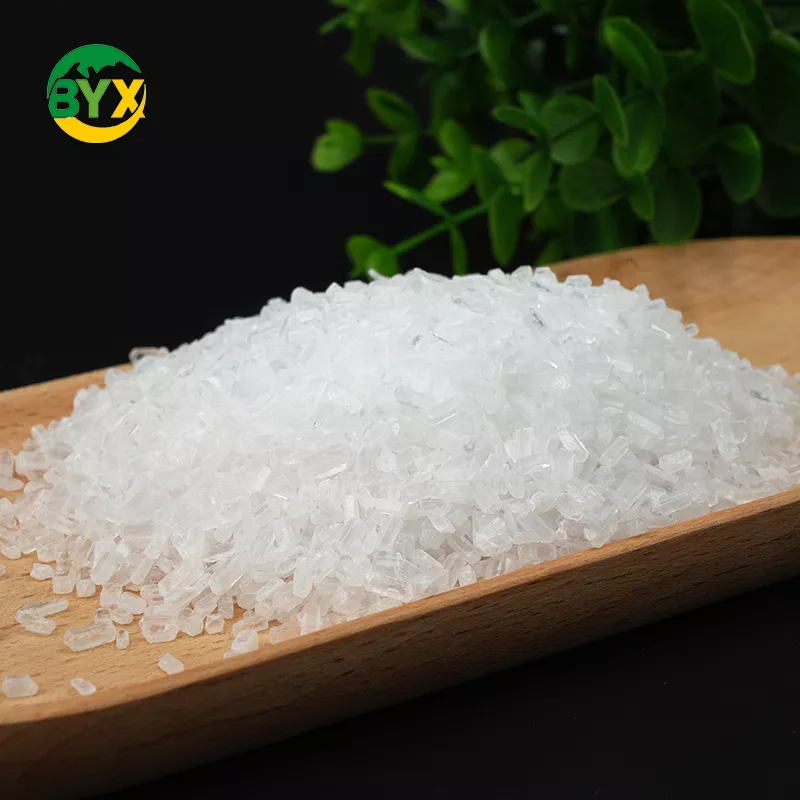
Dry at 50–55°C to obtain Magnesium Sulfate Heptahydrate. Reuse mother liquor for subsequent batches.
Reaction:
MgO+H2SO4+6H2O→MgSO4⋅7H2O
2. Recrystallization from Salt Lake Brine
Steps:
Concentrate natural brine from salt lakes to produce crude magnesium sulfate.
Dissolve crude MgSO₄ in water at 80–90°C.
Clarify the solution at 60–70°C, then cool to 20–25°C for crystallization.
Centrifuge and dry to yield industrial-grade Magnesium Sulfate Heptahydrate.
For pharmaceutical use: Purify industrial-grade product via recrystallization with distilled water, pH adjustment, and dehydration.
3. Seawater Solar Evaporation (Bittern Process)
Procedure:
Evaporate seawater-derived bittern to produce "high-temperature salt" (30% MgSO₄, 35% NaCl, 7% MgCl₂).
Leach the salt with 200 g/L MgCl₂ solution at 48°C to dissolve MgSO₄ selectively.
Cool the leachate to 10°C to crystallize crude MgSO₄·7H₂O.
Refine via double recrystallization for high-purity output.
Key Control: Monitor NaCl solubility to minimize contamination.
4. Impurity Removal via Co-Precipitation
Purification:
Add NaOH to a MgSO₄·7H₂O solution to precipitate Mg(OH)₂, which adsorbs impurities (Ni, Co, Fe, Zn, Cu).
Wash the precipitate and reintroduce it into a boiling MgSO₄ solution.
Stir vigorously for 30 minutes, settle overnight, and siphon the purified solution.
Recrystallize to obtain ultra-pure MgSO₄·7H₂O.
5. Chloride-Free Reagent-Grade Production
Steps:
Dissolve 20 kg industrial MgSO₄ in 30 kg distilled water.
Add excess Ag₂SO₄ to remove chloride ions. Filter and test for Cl⁻ using NH₄SCN.
Neutralize residual acidity with MgCO₃, then treat with H₂S gas to precipitate heavy metals.
Concentrate the solution at 110°C, cool to crystallize, and dry at 50–60°C.
Quality Check: Use bromothymol blue indicator (pH endpoint: blue coloration).
6. High-Purity Magnesium Sulfate Heptahydrate for Spectroscopy
Synthesis:
Slurry 1 kg high-purity MgO with 1 L deionized water.
Slowly add 30% H₂SO₄ until effervescence subsides.
Filter, concentrate the filtrate, and crystallize using rapid cooling.
Wash crystals twice with chilled deionized water and dry at low temperatures.
For anhydrous MgSO₄: Heat heptahydrate at 238°C.